


Help reduce documentation for bedside staff1
Research studies have estimated how much of a shift nurses spend on documentation. One U.S. study shows how task delegation and tech enablement including virtual nursing, virtual monitoring and ambient monitoring can help nurses reclaim time.1

Nurses spend 15 to 25% of their shift on documentation including charting and review1,2

Nurses think they should spend about 13% of their shift on documentation1

A potential net time savings of 15 to 30% through delegation or tech enablement1
Offload administrative tasks and scale staff with a virtual model
Virtual nurses interact with patients directly via a screen in the patient’s room and can access pertinent information from the EHR and other integrated systems during virtual care sessions.

Offload administrative tasks
Offload admission, rounding, discharge, patient education and clinical documentation to virtual nurses to help reduce delays in patients’ journey through the hospital and drive throughput.
Bring in the extended care team
Bedside care providers can bring in members of the extended care team to support workflows like dual medication administration, pharmacy consultations and telepsychiatry, supporting quality care.
Scale experienced nurses
Experienced nurses can teach their peers and coach new nurses through a virtual model, helping to scale experienced resources, improve patient outcomes and prepare new generations of nurses.1
Product highlights
Always-aware ambient sensors

Transform healthcare facilities into smart spaces
Always-aware ambient sensors are advanced, AI-driven devices embedded within care environments that act as the eyes, ears and intelligence of care.ai solutions.
Protect patient privacy
Using computer vision and AI-driven algorithms, sensors continuously monitor activity to autonomously detect presence, motion and behavior without intruding on patient privacy. Ambient sensors capture real-time data, infer patterns and identify deviations. They can notify appropriate care providers if a situation needs attention.
Help drive standardization and optimize workflows
Sensors can monitor for facility protocol compliance to help drive standardization and optimize clinical and operational workflows.
Virtual command center
The virtual command center is the intelligence hub for care.ai solutions, bringing together virtual care and ambient intelligence into one seamless experience. For virtual care workflows, care providers work from the command center supporting a curated task list or monitoring multiple patients at once.

Automate workflows, streamline compliance monitoring
In Ambient Monitoring scenarios, the command center draws on near-real-time data from always-aware ambient sensors. It automates workflows, streamlines facility protocol compliance monitoring and delivers actionable insights that support proactive interventions.
Get a single source of truth for situational awareness
The command center unifies capabilities, systems and more, delivering predictive intelligence and enterprise-wide visibility to enable smarter, more human-centered care. The command center can integrate with a wide variety of systems like the EHR, nurse call, documentation tools, interpretation services and IoT devices.
Support flexibility in managing care delivery
The command center’s workflow orchestration tools support flexibility in managing aspects of care delivery like receiving and completing tasks or notifying team members.
Consultative partnership
We believe transformation in healthcare requires more than just technology – it requires trusted partnership and deep clinical experience. Our platform is built hand-in-hand with frontline clinicians. We continuously incorporate their insights to address real-world challenges like workforce shortages, administrative burdens and patient safety risks.

Align with your protocols and processes
We don’t just deliver tools; we want to be your partner, aligning with your leadership and care teams to co-design solutions that align with your protocols and processes.
Integrate seamlessly
Our implementation teams work to integrate your care.ai solutions seamlessly with your existing systems.
Help ensure solution adoption
Our clinical specialists collaborate with your clinical leaders to help ensure solution adoption, support your team training and education efforts and work with you to quantify outcomes.
FAQs
In Virtual Nursing, virtual nurses interact with patients directly via a screen in the patient’s room. Virtual nurses perform top-of-license practices and also support workflows such as admission, rounding, discharge and nurse documentation in accordance with your facility’s protocols and standards.
Virtual nurses work from a virtual command center supporting a curated task list, which can allow bedside clinical team more time to focus on hands-on patient care.
Virtual Nursing can help a hospital attract and retain nurses by allowing flexibility in the type of work nurses perform (virtual or hands-on or a combination). Some hospitals have team members who work only as virtual care providers, leveraging an experienced workforce that has retired, or experienced senior nurses who want to move away from bedside acute care but still practice and mentor. Virtual Nursing is a great avenue for experienced nurses to provide mentorship to new practice nurses throughout a facility or health system.
Yes. Because some patients may need multiple layers of care, Virtual Nursing sessions can be run simultaneously with Virtual Monitoring and/or Ambient Monitoring using a single ambient monitoring sensor.
Interested in learning more? Contact an expert.
Thank you for your interest in our Sync Badge. A Stryker representative will reach out to you shortly.
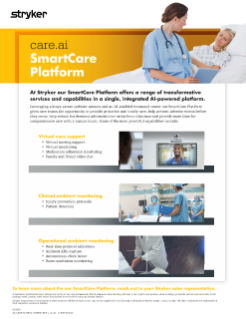
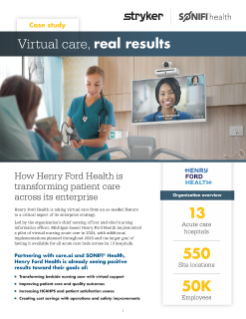

Ambient Monitoring
Powered by AI-driven, always-aware ambient monitoring sensors, our integrated, cloud-based solutions enhance and automate clinical and operational workflows.
Learn more
Virtual Monitoring
Scale virtual sitter resources by performing workflows like patient monitoring and night rounding through a virtual model.
Learn more
Vocera Engage
Vocera Engage middleware is the core of Vocera’s communication and workflow intelligence. It provides care teams a more complete picture of a patient’s situation, enabling prompt communication and helping to enhance patient safety.
Learn more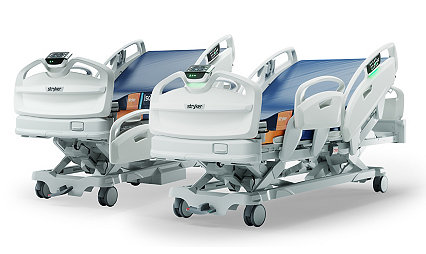
ProCuity LEX / ZX
Designed to enhance safety and outcomes in MedSurg while delivering a better experience for care teams, with a focus on supporting fall prevention protocols.
Learn moreReferences:
1. McKinsey and Company. Reimagining the nursing workload: Finding time to close the workforce gap. May 2023. Retrieved September 16, 2024.
2. Yen PY, Kellye M, Lopetegui M, Saha A, et al. Nurses' Time Allocation and Multitasking of Nursing Activities: A Time Motion Study. AMIA Annu Symp Proc. 2018 Dec 5;2018:1137-1146. PMID: 30815156; PMCID: PMC6371290. Retrieved September 16, 2024.
AC-GSNPS-SYK-1946350_REV-0_en_us