

Triathlon®
Medial Stabilized Insert
A trusted legacy strengthened through innovation
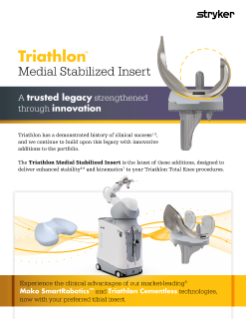
A medial stabilized tibial insert that adds increased medial conformity1-3 to the Triathlon Total Knee System, designed to deliver enhanced stability1-3 and more native rotational kinematics.4 Experience the clinical advantages of our market-leading5 Mako SmartRobotics™ and Triathlon Cementless technologies, now with your preferred tibial insert.

A medial stabilized design, built on proven Triathlon performance
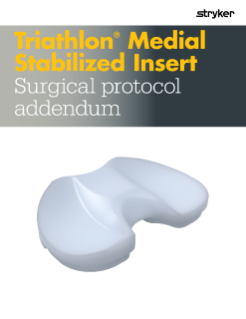
Its articulating surface is designed with increased conformity1-3 in the medial compartment, paired with a relaxed posterolateral geometry, to add medial stability1-3 while allowing for more native rotational kinematics4 compared to the clinically successful Triathlon CS Insert.6-8
Built on the same Triathlon femoral and tibial components, it adds a medial stabilized insert to a system with a proven history of clinical success.6-8
A trusted Triathlon platform, now with a medial stabilized insert
A medial stabilized bearing, backed by the demonstrated clinical success of Triathlon6-8 and the market-leading5 Mako SmartRobotics™ and Triathlon Cementless technologies, so you can add enhanced stability1-3 to a proven knee system.

Enhanced stability and kinematics
Triathlon's single-radius design provides consistent ligament tension and stability through active flexion.9-10 The medial stabilized geometry builds on that to deliver enhanced stability1-3 while allowing more native rotational kinematics,4 both with and without an intact PCL in simulation testing. In cadaveric testing, motion trended toward native knee kinematics.11

Reproducible execution
Implant design and positioning work together to impact knee stability and kinematics.12 Pair the MS Insert with patient-specific, CT-based planning and the precision13 of AccuStop™ haptic technology of Mako SmartRobotics™. This combination allows for a personalized workflow and helps you achieve your preferred alignment philosophy with confidence.

Trusted performance
The MS Insert joins the Triathlon Total Knee System and its proven history of stability,10 satisfaction14 and excellent long-term survivorship.6-8 This is reinforced by the trusted fixation15-16 of Triathlon Cementless: greater than 99% survivorship for aseptic loosening at 10 years15-16 and high patient satisfaction15,17 on top of its improved efficiency18-20 vs. cemented TKA.
Intraoperative flexibility and a metal sensitivity option
The MS Insert can be implanted with the PCL retained or resected, giving you a single, versatile option for your surgical philosophy and each patient's needs. It is also the first insert in the Triathlon portfolio to use a titanium alloy locking wire rather than cobalt chrome locking wire. Paired with the Triathlon Gold Femoral Component and Triathlon Tritanium Baseplate, it provides a comprehensive option for patients with metal sensitivity concerns.



Send us a message to learn more about Triathlon MS Insert.
This contact form is intended for healthcare professionals. If you’re a patient looking for more information, please use the patient path.
Thank you!
References
- D0000373518. Virtual Range of Constraint Measurement of Triathlon Medial Stabilized Insert Family in Extension.
- D0000361177. Virtual Range of Constraint Measurement of Triathlon Medial Stabilized Insert Family in Active Flexion.
- D0000373525. Virtual Range of Constraint Measurement of Triathlon Medial Stabilized Insert Family in Deep Flexion.
- D0000367859. Knee Kinematic Model (KKM) Library Verification of the Medial Stabilized Insert.
- Orthopedic Network News 2025 Hip and Knee Implant Review. Volume 36, Number 3, September 2025. Curvo Labs, Inc.
- American Joint Replacement Registry (AJRR): 2025 Annual Report. Rosemont, IL: American Academy of Orthopaedic Surgeons (AAOS), 2025.
- National Joint Registry: 22nd Annual Report 2025: Surgical data to 31 December 2024.
- Australian Orthopaedic Association National Joint Replacement Registry (AOANJRR). Hip, Knee & Shoulder Arthroplasty Annual Report 2025.
- Cook L, Klika A, Szubski C, Rosneck J, Molloy R, Barsoum W. Functional Outcomes Used to Compare Single Radius and Multiradius of Curvature Designs in Total Knee Arthroplasty. J Knee Surg 2012;25:249–254.
- Larsen et al. Quantitative, Comparative Assessment of Gait Between Single-Radius and Multi-Radius Total Knee Arthroplasty Designs, J Arthroplasty (2015).
- Hampp E, Szabo N, Ali AA, et al. Comparison of kinematics and anteroposterior stability between medial-stabilized and condylar-stabilized inserts in robotic-assisted TKA. Poster presented at the Orthopaedic Research Society Annual Meeting; 2026; Charlotte, NC.
- Angerame MR, Holst DC, Jennings JM, Komistek RD, Dennis DA. TotalKnee Arthroplasty Kinematics. J Arthroplasty. 2019;34(10):2502-2510.doi:10.1016/j.arth.2019.05.037.
- Deckey DG, Rosenow CS, Verhey JT, et al. Robotic-assisted total knee arthroplasty improves accuracy and precision compared to conventional techniques. Bone Joint J.2021;103-B(6 Supple A):74-80. doi:10.1302/0301-620X.103B6.BJJ-2020-2003.R1
- Scott CEH, Snowden GT, Cawley W, et al. Fifteen-year prospective longitudinal cohort study of outcomes following single radius total knee arthroplasty. Bone Jt Open. 2023;4(10):808-816. Published 2023 Oct 24. doi:10.1302/2633-1462.410.BJO-2023-0086.R1
- Stoltz MJ, Mullick M, Smith LS, Duncan AE, Yakkanti MR, Malkani AL. Primary Total Knee Arthroplasty Using a Cementless Highly Porous Titanium Tibial Baseplate: A Minimum 10-Year Follow-Up. J Arthroplasty. 2025 Jul 28:S0883-5403(25)00956-8. doi: 10.1016/j.arth.2025.07.053. Epub ahead of print. PMID: 40738233.
- Zappley, Nicolina R., et al. “10-year follow-up for a new three-dimensional printed cementless total knee arthroplasty.” The Journal of Arthroplasty, vol. 40, no. 7, July 2025, https://lnkd.in/ef4_MiFK.
- Hannon CP, Salih R, Barrack RL, Nunley RM. Cementless Versus Cemented Total Knee Arthroplasty: Concise Midterm Results of a Prospective Randomized Controlled Trial. JBJS. 2023 Jun 22:10-2106.
- Nam, D, et al. Cemented Versus Cementless Total Knee Arthroplasty of the Same Modern Design: A Prospective, Randomized Trial. The Journal of Bone and Joint Surgery 101(13):p 1185-1192, July 3, 2019. | DOI: 10.2106/ JBJS.18.01162
- Sharpe, K., Robinson, K., Cohen, R., Barnett TM., Rastogi, A., Masini, M. Does Implant Fixation Affect Early Return to Function Following Primary Total Knee Arthroplasty. ISTA 2018. London, UK.
- Lawrie CM, Schwabe M, Pierce A, Nunley RM, Barrack RL. The cost of implanting a cemented versus cementless total knee arthroplasty. Bone Joint J. 2019 Jul;101 B(7_Supple_C):61-63. doi: 10.1302/0301-620X.101B7.BJJ-2018- 1470.R1. PMID: 31256655.
JR-GSNPS-SYK-3982200