


Where fit and simplicity unite as one.
We recognize the challenges you face and the diverse patients you care for every day. That understanding, paired with our unwavering commitment to innovation, led us to ask: What’s next for you and your patients?
The answer is our Pangea plating portfolio. A new system that is designed to meet your needs for anatomical fit1 and simplicity.

20
anatomic plates
13
utility plates
1
platform
Pangea empowers you to treat a diverse patient population with confidence. Shaped by the collaborative efforts of 26 world-renowned orthopaedic surgeons and directly informed by Stryker Orthopaedic Modeling and Analytics (SOMA), Pangea is a portfolio of anatomically informed implants.1


Universal holes offer 30º cone of angulation
20 Anatomic plates

HUMERUS
• Proximal Humerus
• Proximal Humerus Posterior
• Extra Articular Distal Humerus

PERIPRO FEMUR
• Proximal Femur
• Distal Femur
• Interprosthetic Femur

DISTAL FEMUR
• Distal Lateral Femur
• 5.0 Distal Medial Femur
• 3.5 Distal Medial Femur

PROXIMAL TIBIA
• Extra Articular Proximal Tibia
• Partial Articular Proximal Tibia
• Proximal Lateral Tibia
• Proximal Posteromedial Tibia
• Proximal Medial Tibia

DISTAL TIBIA
• Distal Anterolateral Tibia
• Distal Medial Tibia
• Distal Posterior Tibia

DISTAL FIBULA
• Distal Lateral Fibula
• Distal Posterolateral Fibula
• Distal Posterior Fibula
13 Utility plates

LARGE FRAGMENT
• 5.0 Narrow Straight Plate
• 5.0 Broad Straight Plate
• 5.0 Broad Curved Plate

SMALL FRAGMENT
• 3.5 Broad Straight Plate
• 3.5 Narrow Straight Plate
• 3.5 Hook Plate
• 3.5 T-plate
• 3.5 Narrow Curved Plate
• 3.5 1/3 Tubular Plate

MINI FRAGMENT
• 2.7 Narrow Straight Plate
• 2.7 Broad Straight Plate
• 2.7 Hook Plate
• 2.7 T-plate
You deserve the confidence that comes from a simple, innovative, and comprehensive system.
Guided by the experience of leading orthopaedic surgeons, Pangea was designed with your needs in mind. Embrace the simplicity of a global platform, providing everything you need and nothing you don’t.

Pangea Plating System resources
Discover more about the Pangea Plating System by exploring our collection of clinical resources including surgical techniques, and product overview videos, brochures, whitepapers, and more.
Pangea | Distal Anterolateral Tibia Plate - Surgical Animation
Pangea | Distal Lateral Fibula Plate - Surgical Animation
Pangea | Proximal Humerus Plate - Surgical Animation
Pangea | Proximal Lateral Tibia Plate - Surgical Animation
Pangea | Distal Lateral Femur Plate - Surgical Animation
Operative Techniques
Tibia plates
- Pangea Distal Tibia Plating System - Operative Technique
- Pangea Tibia Plating System - Operative Technique
Fibula plates
Humerus plates
- Pangea Proximal Humerus Plating System - Operative Technique
- Pangea Humerus Plating System - Operative Technique
Femur plates
- Pangea PeriPRO Femur Plating System - Operative Technique
- Pangea Distal Femur Plating System - Operative Technique
Utility plates
FAQs
Pangea by Stryker is a comprehensive variable-angle plating system portfolio developed for the internal fixation and stabilization of fractures, osteotomies, and arthrodesis in orthopaedic trauma. The system includes anatomically contoured and utility plates across mini-fragment, small-fragment, and large-fragment applications. Pangea was designed to address common challenges in trauma surgery such as plate fit variability, complex instrumentation, and the need for versatility across a wide range of fracture patterns and patient anatomies. Its design is informed by anatomical data and surgeon collaboration, with the goal of enhancing implant fit, screw placement, and simplifying procedural workflows.
Pangea is intended for use in orthopaedic trauma procedures involving upper and lower limb surgery, supporting fracture fixation and long bone plating across anatomical regions. This includes specific bones such as the humerus, femur, tibia, and fibula. It supports the treatment of diaphyseal, metaphyseal, and epiphyseal fractures, as well as extra articular and intra articular fractures, non unions, malunions, deformities, and periprosthetic fractures. The system is indicated for use in normal and osteopenic bone and may be used in adult, adolescent, and select pediatric patients when growth plates are fused or not crossed by implants. Pangea is designed for use across hospital settings, from high acuity trauma centers to institutions managing a wide spectrum of fracture complexity.
Pangea supports clinical decision making primarily through implant design, intraoperative flexibility, and streamlined, intuitive instrumentation. The system offers variable angle locking plate technology that allows surgeons to adjust screw trajectories within a defined range to accommodate fracture anatomy and fixation strategy. Hybrid locking and compression holes provide the option to apply compression or locking fixation based on intraoperative needs. In addition, Pangea’s simplified and consistent instrumentation platform, shared screw system, and color coded organization are designed to improve efficiency, reduce complexity in the operating room, and support confident intraoperative decision making, reinforcing the system’s focus on Fit and Simplicity.
Pangea is supported by non-clinical testing, anatomical modeling, and internal comparative fit assessments. The system was developed using Stryker Orthopaedic Modeling and Analytics (SOMA), which incorporates thousands of clinical CT scans and three-dimensional bone models representing diverse patient populations. The system has also undergone non-clinical laboratory testing for mechanical performance, including screw pull-out, shear, bending, fatigue, and MRI conditional testing, conducted in accordance with applicable standards.
Effective transition to the Pangea system is supported by Stryker’s established training, education, and customer-support infrastructure. Hospitals and surgical teams have access to education and training programs designed to support the implementation of Pangea and promote consistent use across clinical settings. The system’s streamlined instrumentation, shared screw platform, and color-coded design are intended to simplify onboarding for new staff and support familiarity across procedures and indications. These design elements help reduce variability and reinforce standardization within the surgical workflow. In addition, Stryker’s change-management resources provide partnership and guidance throughout implementation. This support is designed to help teams transition efficiently to the Pangea plating system through structured planning, close collaboration, and ongoing educational offerings.
Related products

Gamma4
Hip fracture solution for treatment of fractures in the intracapsular, trochanteric, subtrochanteric and shaft regions of the femur
Learn more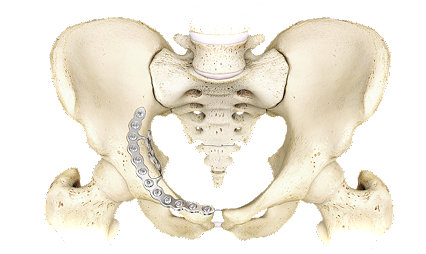
Contact us
Send us a message to learn more about Pangea and its capabilities.
Thank you for your message. Our team will get back to you shortly with more information!
Follow Stryker's Trauma team on Social Media!
TEACH: Education for the driven
Explore our Medical Education offering for trauma care in EMEA

References:
- Internal Report № D0000262573, Rev AA.
TR-PANG-SYK-3083650_Rev-2