


Exeter®
Cementing our place in history
Share in over 50 years of esteemed heritage. The Exeter hip stem is an established cemented solution to total hip arthroplasty and continues to be a leading choice of implant as shown in several national joint registries.1-3 Since its launch in 1970, over 160 Exeter stems on average have been implanted per day.4 This hip system, which has remained a market leader in multiple countries for a few decades5, is designed to accommodate an expansive variety of cases with one system.
Key benefits
With over 50 years of proven clinical history that has transformed the lives of over 2.1 million patients, Exeter has demonstrated successful clinical performance in peer-reviewed medical journals and national joint registries.1–5
In a minimum 20 year follow-up study of 382 cemented Exeter Universal* THAs and mean patient age of 66.3 years, survivorship of the stem at 22.8 years was 99.0% with an endpoint of revision for aseptic loosening or lysis.7
*The Exeter Universal stem evaluated in this study is a predecessor version of the currently marketed Exeter stem and is no longer commercially available in certain markets including EU.
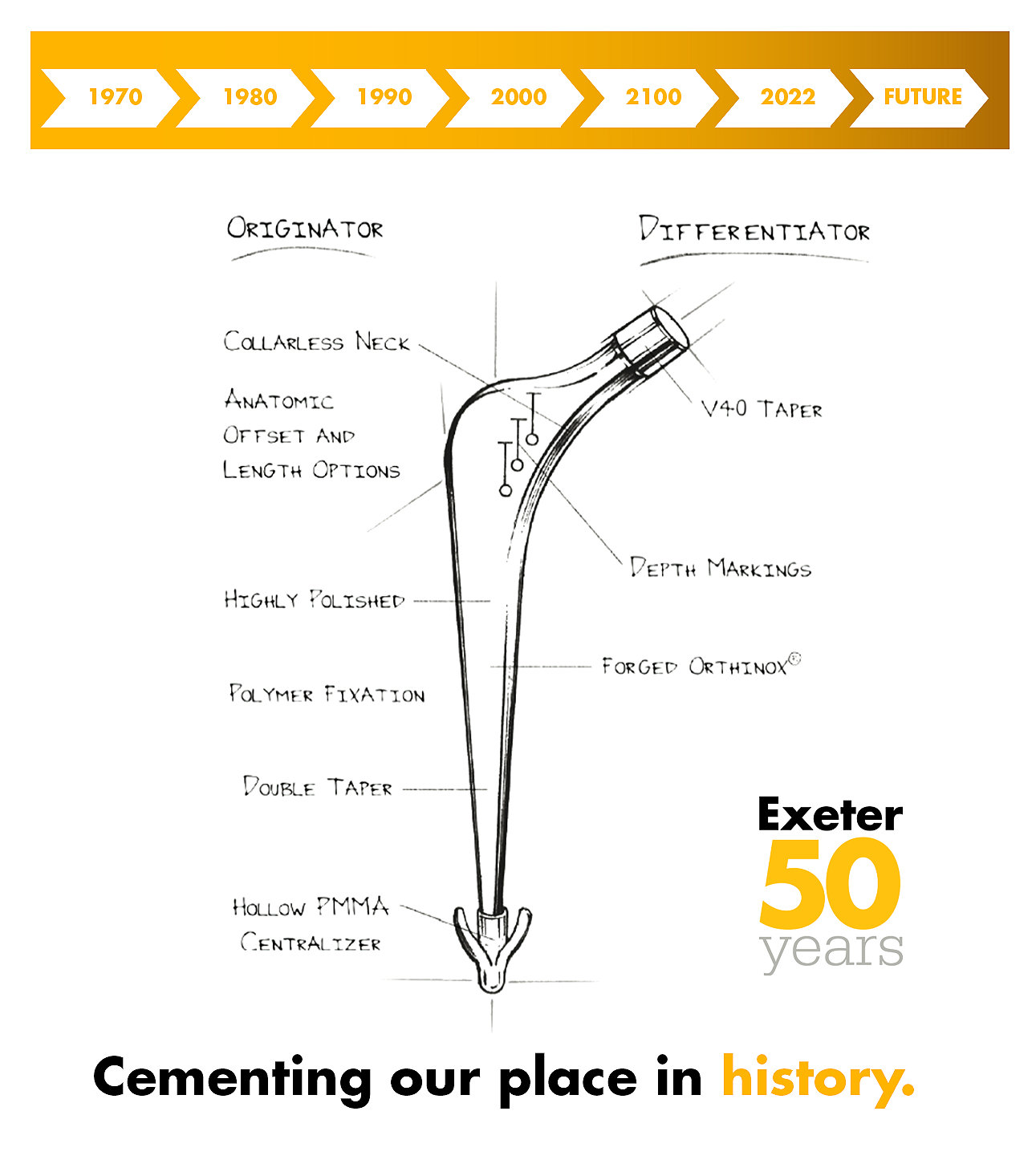
Exeter offers a wide range of offset and body size variations to fit varying morphologies.
29 stems with 30-56mm offset range

Offset-based system
Multiple offset options and body sizes allow fine-tuning of restoring the head center, independent of leg length and canal size.
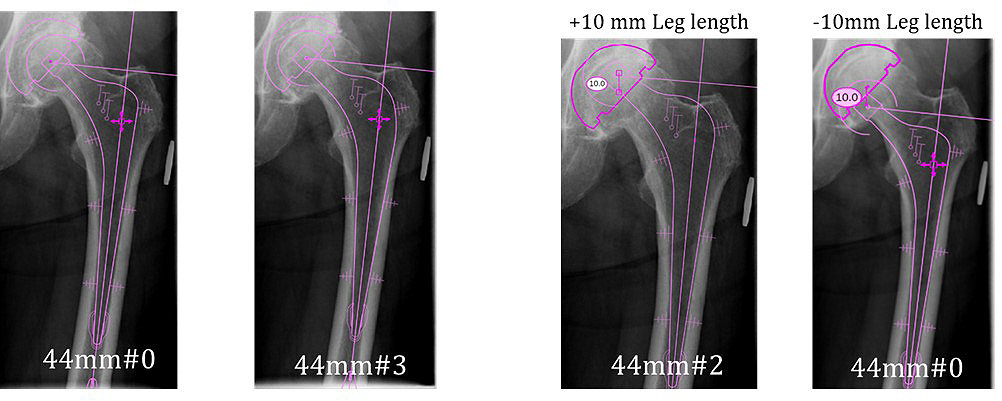
One implant and instrument system that is designed to accommodate primary, revision, and hip fracture cases.

The collarless design of Exeter allows for independent correction of leg length and version. Combined with a wide range of offset options, Exeter is a versatile system for anatomic restoration.
Clinical evidence
In one study, the authors concluded “The hybrid Exeter V40 Trident seemed to produce the best overall results.”6
In patients over 75 years old, early revision was 9.14x more common in the best three cementless stems compared to the best three cemented stems in the Australian registry.8 In a National Joint Registry analysis of more than 660,000 total hip replacements conducted in 2020, the implant constructs routinely used at the Exeter Hip were associated with superior long-term implant survival and lower revision rates compared with the national average.9
Kaplan-Meier survival

“The Exeter Universal* cemented stem has excellent survivorship at minimum 20 years in young patients [107 patients under 50 years of age].”10
“No stem was revised for aseptic loosening in this series [featuring 540 total hip arthroplasties]. The contemporary Exeter V40 stem continues to perform well, and survival has remained comparable with that of the Exeter Universal stem.”11
*The Exeter Universal stem evaluated in this study is a predecessor version of the currently marketed Exeter stem and is no longer commercially available in certain markets including EU.
Mako compatibility

Mako SmartRobotics™ combines 3D CT-based planning and AccuStop™ haptic technology into one platform that is designed to offer a premium clinical and operational experience when compared to manual surgery across Mako Total Hip, Total Knee and Partial Knee.
Mako SmartRobotics™ with Exeter empowers surgeons to know more through CT-based planning, unlocking patient specific planning and robotic-arm assisted execution which is designed to help preserve acetabular bone11, reduced blood loss12 and greater ability to reproduce hip biomechanics13-16 versus manual technique. The system includes approach-specific registration workflows designed to support muscle-sparing surgical approaches.
References:
- National Joint Registry for England, Wales and Northern Ireland and Isle of Man. 22th Annual Report. 2025.
- National Joint Replacement Registry. Hip, Knee & Shoulder Arthroplasty Annual Report 2025. Australian Orthopaedic Association; 2025.
- Swedish Hip Arthroplasty Register 2024.
- Stryker sales data 1970-2025.
- Thompson JW, Corbett J, Bye D, Jones A, Tissingh EK, Nolan J. Analysis of the Exeter V40 femoral stem prosthesis fracture : systematic review and single centre case series. Bone JtOpen. 2021 Jun;2(6):443-456. doi: 10.1302/2633-1462.26.BJO-2021-0025.R1. PMID:34176335; PMCID: PMC8244800.
- Pennington M, et al. Functional outcome, revision rates and mortality after primary total hip replacement--a national comparison of nine prosthesis brands in England. PLoS One. 2013Sep 4;8(9):e73228.
- Petheram TG, Whitehouse SL, Kazi HA, et al. The Exeter Universal cemented femoral stem at20 to 25 years: A report of 382 hips. Bone Joint J. 2016 Nov;98-B(11):1441-1449. SwedishHip Arthroplasty Register 2016.
- Tanzer M, Graves SE, Peng A, Shimmin AJ. Is Cemented or Cementless Femoral Stem Fixation More Durable in Patients Older Than 75 Years of Age? A Comparison of the Best-performing Stems. Clin Orthop Relat Res. 2018.
- Evans JT, Blom AW, Timperley AJ, et al. Factors associated with implant survival following total hip replacement surgery: A registry study of data from the National Joint Registry of England, Wales, Northern Ireland and the Isle of Man. PLOS Medicine. 2020;17(8):e1003291.
- Keeling P, Howell JR, Kassam AM, Sathu A, Timperley AJ, Hubble MJW, Wilson MJ, Whitehouse SL. Long-Term Survival of the Cemented Exeter Universal Stem in Patients 50 Years and Younger: An Update on 130 Hips. J Arthroplasty. 2020 Apr;35(4):1042-1047. doi: 10.1016/j.arth.2019.11.009. Epub 2019 Nov 14.
- Westerman RW, Whitehouse SL, Hubble MJW, Timperley AJ, Howell JR, Wilson MJ. The Exeter V40 cemented femoral component at a minimum 10-year follow-up: the first 540 cases. Bone Joint J. 2018 Aug;100-B(8):1002-1009. doi: 10.1302/0301-620X.100B8.BJJ-2017-1535.R1.
- Suarez-Ahedo C, Gui C, Martin TJ, Chandrasekaran S, Lodhia P, Domb BG. Robotic-arm assisted total hip arthroplasty results in smaller acetabular cup size in relation to the femoral head size: a matched-pair controlled study. Hip Int. 2017;27(2):147-152. doi:10.5301/hipint.5000418
- Bukowski BR, Anderson P, Khlopas , Chugtai M, Mont MA, Illgen RL. Improved functional outcomes with robotic compared with manual total hip arthroplasty. Surg Technol Int. 2016;29:303-308.
- Elson L, Dounchis J, Illgen R, et al. Precision of acetabular cup placement in robotic integrated total hip arthroplasty. Hip Int. 2015;25(6):531-536. doi:10.5301/hipint.5000289
- Domb BG, El Bitar YF, Sadik AY, Stake CE, Botser IB. Comparison of robotic-assisted and conventional acetabular cup placement in THA: a matched-pair controlled study. Clin Orthop Relat Res. 2014;472(1):329-336. doi:10.1007/s11999-013-3253-7
- Domb BG, Chen JW, Lall AC, Perets I, Maldonado DR. Minimum 5-year outcomes of robotic-assisted primary total hip arthroplasty with a nested comparison against manual primary total hip arthroplasty: a propensity score-matched study. J Am Acad Orthop Surg. Accepted manuscript. Published online February 25, 2020. doi:10.5435/JAAOS-D-19-00328
- Domb B, Redmond J, Louis S, Alden K, Daley R, LaReau J, et al. Accuracy of component positioning in 1980 total hip arthroplasties: a comparative analysis by surgical technique and mode of guidance. The Journal of Arthoplasty. 30(2015)2208-2218
JR-EXE-SYK-3436250