


Modular Dual Mobility
Mobile Bearing Hip System
Dislocation is one of the most common causes of THA failure in both primary and revision procedures.1-4 Modular Dual Mobility (MDM) is designed to help prevent dislocation and assist your operative goals of stability and longevity for primary or revision total hip arthroplasty cases.
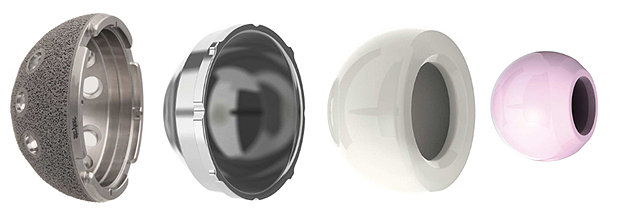
Stryker’s MDM consists of a modular cobalt chrome liner, a large diameter X3 polyethylene insert and a femoral head. The highly polished modular cobalt chrome liner can be assembled into any of Stryker’s acetabular shells utilizing the Trident Locking Mechanism. Together these components result in a dual mobility device with two points of articulation – one between the X3 polyethylene insert and metal liner (external bearing), and the other between the X3 polyethylene insert and the femoral head (internal bearing). Primary motion occurs at the inner bearing while the outer bearing moves in cases of extreme range of motion, which may minimize wear, reduce frictional torque and increase stability.5-6
Key benefits
Stability
Jump distance (mm) measured with a 54mm shell at 45° of inclination and 20° of anteversion8
*Although resurfacing type shells have lower jump heights, they have the greatest ROM which is needed when the native femoral neck is retained.
The X3 polyethylene inserts of the MDM system are available in large sizes offering increased jump distance – the distance the femoral head must travel to dislocate.1 The greater the jump distance, the greater the stability of the hip.7
When compared to a conventional THA with a 36mm femoral head, MDM offers a 59% increase in jump distance.5,8
Versatility
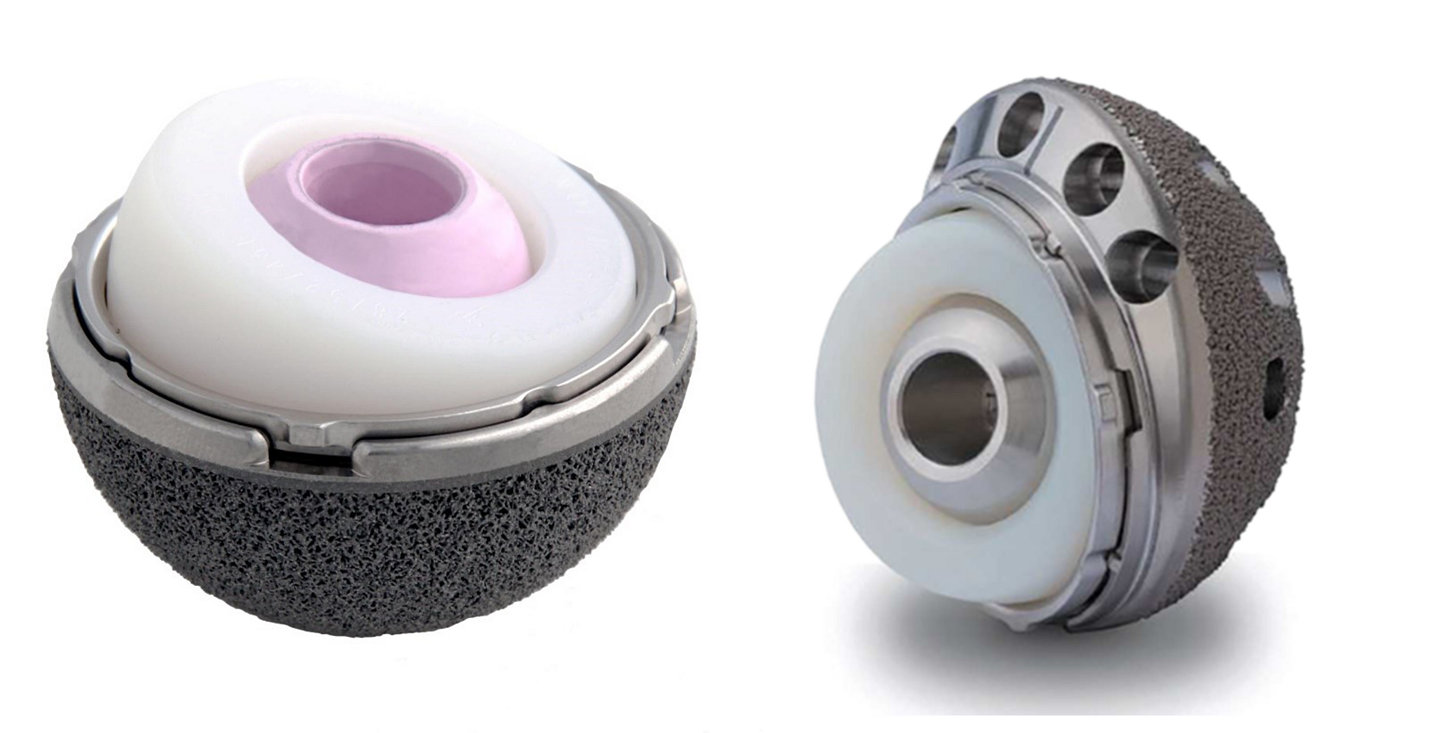
MDM is a versatile bearing option, as its indications include both primary and revision cases.1-4 MDM utilizes the Trident Innerchange Locking Mechanism, allowing surgeons intraoperative flexibility.
MDM X3 is compatible with Trident, Trident II and Restoration Anatomic acetabular components, offering surgeons a choice of fixation surfaces and screw hole configurations.
Longevity
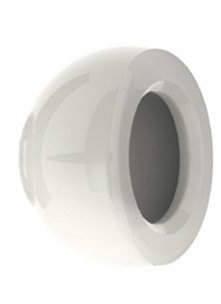
MDM X3 Advanced Bearing Technology is designed to minimize the risk of wear, which may prolong the life of the implant and offer your patients greater implant longevity.6 X3 precisely engineered polyethylene’s manufacturing process of sequential crosslinking uses three separate gamma irradiation doses with an annealing step after each. Our process creates a polyethylene that is strong and intrinsically resistant to wear and oxidation.9-11
Cost-effectiveness
MDM has demonstrated potential for cost reduction by decreasing the risk of dislocations.12-15 At mid-term follow-up, Dual Mobility constructs used in revision THA were associated with a significantly lower risk of reintervention, which translated to lower health care payer costs compared with LFH constructs among European health care payers in 2020.15
The economic outcomes reported in those studies are based on country‑specific healthcare systems, pricing structures and clinical practices - may not be generalizable to other geographies.
Cost Analysis of Dual-Mobility Constructs in Revision Total Hip Arthroplasty in 202015
Dual Mobility
Large Femoral Head
*Value in GBP has been converted to EUR with the average conversion rate from 2020. 1 GBP=1.1248 EUR (https://www.poundsterlinglive.com/history/GBP-EUR-2020)
Clinical evidence
Modular Dual Mobility (MDM), has been shown to deliver stability16 compared to Fixed Bearing and allows adaptability16,17 based on primary, complex or revision indication. Stryker's MDM have shown favorable clinical outcomes17-19 that is backed by data.
Stability
“Dual Mobility demonstrated improved PROMS and lower rates of dislocation, readmission and revision.”
In a 27-center retrospective study of 664 dual mobility vs. 218 fixed bearings, dual mobility demonstrated improved PROMs and lower rates of dislocation, readmission and revision16
Adaptability
“4x reduced incidence of dislocation.”
In a retrospective review of 267 patients who underwent revision, even with a selection bias of using dual mobility for patients at high risk of instability, patients who received an MDM bearing had a 4x reduced incidence of dislocation (2.1%, vs. 8.7% for conventional polyethylene single bearing, P=0.067) at the mean follow-up of 37.8 months17
Clinical outcomes
“Excellent clinical outcomes and patient-reported outcomes at seven-years minimum follow-up (7 - 8.5 yrs.) with zero cup failures in a cohort of 143 patients.”
Excellent clinical outcomes and patient-reported outcomes at seven-years minimum follow-up (7 - 8.5 yrs.) with zero cup failures in a cohort of 143 patients18
Clinical outcomes
“The use of a modular DM component shows excellent mid-term survivorship with minimal concerns for corrosion and metal ion release in a cohort of young, active patients undergoing primary THA.”
In a prospective study of 43 young, active patients undergoing primary THA with a modular dual mobility construct, significant improvements in functional outcomes were observed at five years, with low revision rates and minimal increases in metal ion levels.19
Related products

Novae® Dual Mobility
Novae® Dual Mobility is designed to enhance joint mobility and reduce dislocation risks, following total hip replacement.
Learn more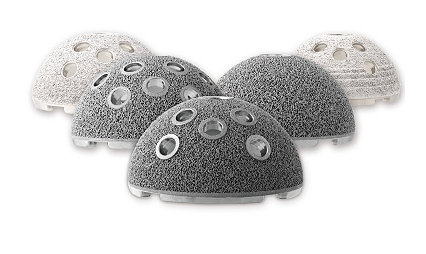
References
- Epinette, J. et al. Early experience with dual mobility acetabular systems featuring highly crosslinked polyethylene liners for primary hip arthroplasty in patients under fifty-five years of age: an international multi-centre preliminary study. International orthopaedics (SICOT). Sept. 2016 DOI 10.1007/s00264-016-3367-0.
- Jauregui, J. et al. Dual mobility cups: an effective prosthesis in revision total hip arthroplasties for preventing dislocations. Hip Int. 2016 Feb 8;26(1):57-61. doi: 10.5301/ hipint.5000295.
- Mont, MA. et al. The Use of Dual-Mobility Bearings in Difficult Hip Arthroplasty Reconstructive Cases. Surg Technol Int. 2011 Dec.; 21:234-40.
- Abdel, M., et al. Dual-Mobility Constructs in Revision THA Reduced Dislocation, Re-Revision & Reoperation Compared to Large Femoral Heads. Hip Society 2017 Otto Aufranc Award.
- Heffernan, C., Bhimji, S.,Macintyre, J., et al. (2011). Development and Validation of a Novel Modular Dual Mobility Hip Bearing. ORS Annual Meeting Poster #1165.
- Herrera, L., Lee, R., Longaray, J., et al. (2010). Edge Loading Wear due to Inclination Angle for Three Contemporary Hip Bearings. 56th Annual ORS Meeting. Poster #2259.
- Philippot R, Camilleri JP, Boyer B, Adam P, Farizon F. The Use of a Dual-Articulation Acetabular Cup System to Prevent Dislocation After Primary Total Hip Arthroplasty: Analysis of 384 Cases at a Mean Follow-Up of 15 Years. International Orthopaedics (SICOT) 2009; 33: 927-932.
- Stryker Test Report: RD-10-073. Range of motion and two and three dimensional jump distance of the Modular Dual Mobility Insert. September, 2010.
- Fatigue Comparison of Various UHMWPE for Hip Applications. Stryker Internal Report #RD-12-049. May, 2012.
- Yau S, et al. Sequential Irradiation and Annealing of Highly Crosslinked Polyethylenes Resists oxidation without sacrificing Physical/Mechanical Properties. 51st Annual Meeting of the Orthopedic Research Society. Poster No. 1670.
- Longaray et al. (2013). Fatigue and Wear Characterization of Various Contemporary Hip Bearing Materials. ORS Annual Meeting: Poster #1779
- Barlow BT, McLawhorn AS, Westrich GH. The cost-effectiveness of dual mobility implants for primary total hip arthroplasty: a computer-based cost-utility model. J Bone Joint Surg Am. 2017;99(9):768-777. doi:10.2106/JBJS.16.00109
- Abdel MP, Miller LE, Hanssen AD, Pagnano MW. Cost analysis of dual-mobility versus large femoral head constructs in revision total hip arthroplasty. J Arthroplasty. 2019;34(2):260-264. doi:10.1016/j. arth.2018.09.085
- Epinette, J.A., et al. Cost-effectiveness model comparing dual-mobility to fixed-bearing designs for total hip replacement in France. Orthop Traumatol Surg Res, 2016. 102(2): p. 143-8
- Abdel, M.P., et al. Cost analysis of dual-mobility constructs in revision total hip arthroplasty: a European payer perspective. Orthopedics. 2020 Jul 1;43(4):250-255. doi: 10.3928/01477447-20200625-01.
- Dubin JA, Westrich GH. Lack of early dislocation for dual mobility vs. fixed bear- ing total hip arthroplasty: A multi-center analysis of comparable cohorts. J Or- thop. 2020;21:1-5.
- Li WT, Kozick Z, Sherman M, Restrepo C, Smith EB, Courtney PM. Dual Mobil- ity Bearing Articulations Result in Lower Rates of Dislocation After Revision Total Hip Arthroplasty. J Am Acad Orthop Surg. 2020;28(20):831-837.
- Tarazi JM, Salem HS, Ehiorobo JO, et al. Mini- mum 7-year outcomes of dual mobility acetabular cups in total hip arthro- plasty patients. J Hip Surg. 2020;04(02):090- 093. doi:10.1055/s-0040- 1713109doi:10.1055 /s-0040-1713109
- Lawrie CM, Barrack RL, Nunley RM. Modular dual mobility total hip arthroplasty is a viable option for young, active patients: a mid-term follow-up study. Bone Joint J. 2021 Jul;103-B(7 Supple B):73-77. doi: 10.1302/0301-620X.103B7. BJJ-2021-0145.R1. PMID: 34192909.
JR-GSNPS-SYK-3207302