

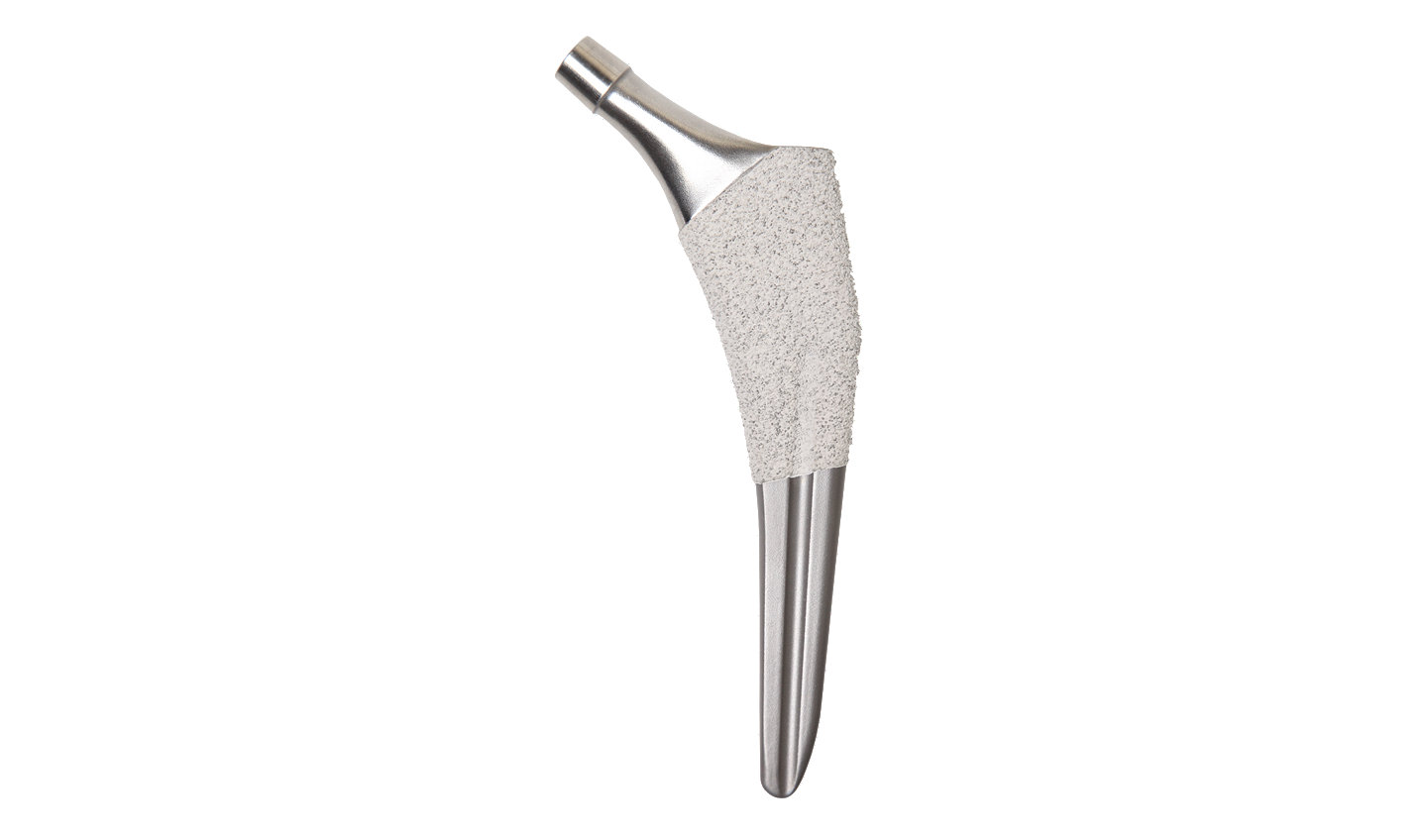
Accolade II
Designed to fit more patients, designed to fit your approach
Accolade II’s Morphometric Wedge is designed to address modern demands with technology by evolving conventional tapered wedge femoral stem design with size specific medial curvature to more closely fit a broad range of bone sizes and shapes of today’s patient population.1
SOMA
Stryker Orthopaedic Modeling and Analytics (SOMA)
Stryker Orthopaedic Modeling and Analytics, or SOMA, is a system that enables population-based design and has powerful functionality with which to design, model and analyze novel orthopaedic devices. Stryker utilized SOMA technology to design a stem building upon the conventional tapered wedge femoral design, incorporating features to allow for an enhanced implant fit in today’s patient population.2
By establishing an increased canal fit and fill2, Accolade II has been shown to allow for enhanced stability2, decreased intraoperative femoral fractures3, as well as excellent survivorship and functional outcomes4,5, which has been shown to lead to satisfied patients.5 An illustrated look at the process by which SOMA technology is employed in implant design is described below.

1) CT aquisition
The SOMA database continues to acquire CT scans, and currently contains over 37,000 bones.16

2) Segmentation
Once acquired, all bones are segmented into inner and outer cortices.

3) Analysis
Using SOMA tools, bone morphology can be studied in a highly accurate and reproducible manner.

4) Design input
The results of these studies, such as the population Canal Flare Index, can be utilized in impact design.

5) Validation
The resulting implant design can then be validated using SOMA fitting tools.
Key benefits
Unique size-specific medial curvature

- Offers increasing proximal conformity to enhance primary stability.6,7
- Initial stability may be increased by creating a higher conformity between the implant and the femoral cortices, leading to a larger area of contract.8
Enhanced proximal-distal proportions1

- Distal-only engaged femoral stems can experience stress shielding8 and consequently may lead to elevated failure rates due to loosening and migration.2 In order to better mimic the femoral anatomy and avoid distal-only engagement, a more anatomic implant growth rate is needed.
- Utilizing the SOMA femoral morphology study, a more anthropomorphic proximal-distal stem growth rate was identified. This rate led to enhanced implant proportions4, as the distal geometry of Accolade II increases in size less than the proximal geometry.
- These proportions enable Accolade II to achieve a significantly better canal fit and fill2, and Accolade II has shown a decreased incidence of distal-only engagement.2
Optimized stem length

- There exists a complex relationship between stem length and implant stability.10 Shortening stem length without geometry optimization has been shown to increase the potential for micromotion10, which is a strong indicator for implant failure.11
- Accolade II utilized the SOMA database* and stability analyses to establish an optimized length for each stem size which not only accommodates muscle-sparing approaches10, but demonstrated improved initial stability.12
- Muscle-sparing surgical approaches continue to gain popularity, due to the potential patient benefits of faster recovery13,14, less pain13,14 and greater satisfaction.15
*SOMA-design of Accolade II based on 556 CT scans.
Clinical performance
over
2,300,000
implanted
2,300,000
implanted
worldwide17
556
bones
bones
in SOMA Accolade II database16
99.2%
survivorship
for Accolade II pursuant to a 3.5-year mean study4
less than
0.1mm
subsidence pursuant to
0.1mm
subsidence pursuant to
2-year RSA study12
4.31x
less intraoperative fractures
less intraoperative fractures
observed compared to conventional tapered wedge3
References
- Wuestemann T, Bastian A, Parvizi J, Nessler J, Kolisek F. A novel tapered hip stem design optimized for femoral fit in a wide array of bone types. 2011 EFFORT.
- Issa, K et al. Radiographic Fit and Fill Analysis of a New Second-Generation Proximally Coated Cementless Stem Compared to its Predicate Design. Journal of Arthroplasty (2013). http://dx.doi.org/10.1016/j.arth.2013.04.029.
- Colacchio ND, Robbins CE, Aghazadeh MS, Talmo CT, Bono JV. Total Hip Intraoperative Femur Fracture: Do the Design Enhancements of a Second-Generation Tapered-Wedge Stem Reduce the Incidence? J Arthroplasty. 2017 Oct;32(10):3163-3168. doi: 10.1016/j.arth.2017.05.012. Epub 2017 May 15. PMID: 28648706.
- Pierce T. et al. Second-Generation Versus First-Generation Cementless Tapered Wedge Femoral Stems. Orthopedics. 2015 38(9): 550-554.
- Kolisek, F. et al. Outcomes of Second-Generation Tapered Wedge Design. SurgTechnolInt. 2016 Apr 4; XXVIII. pii: sti28/702.
- Stryker Internal presentation ‘Global Bone Morphology Study-Proximal Femur’. November 10, 2016.
- Narzikul, BS et al. Alternation in Geometry of Femoral Stem Results in Better Fit and Fill: Comparison of Accolade I vs. Accolade II. Presentation at 47th Annual EOA Meeting – New Orleans, LA, October 19-22, 2016.
- Khanuja H, et al. Current Concepts Review: Cementless Femoral Fixation in Total Hip Arthroplasty. J Bone Joint Surg Am. 2011;93:500-9.
- Boucher, F. et al. Preclinical Finite Element Analysis of a Novel Tapered Wedge Stem Optimized for Stability at a Reduced Length. 2011 EFORT Poster Presentation.
- Faizan A, et al, Development and Verification of a Cementless Novel Tapered Wedge Stem for Total Hip Arthroplasty, J Arthroplasty (2014), http://dx.doi.org/10.1016/j.arth.2014.09.023.
- Van der Voort, P. et al. Early subsidence of shape-closed hip arthroplasty stems is associated with late revision, Acta Orthopaedica 2015 86:5, 575-585, DOI: 10.3109/17453674.2015.1043832.
- Collopy, D. et al. A Prospective Roentgen Stereophotogrammetric Analysis (RSA) Study of the Stryker Accolade II Cementless Hipo Stem to 2 Years Post-Surgery. Abstracts from 2016 Annual AOA Meeiting–Cairns, QLD, October 9-13, 2016.
- Restrepo C, Parvizi J, Eslam Pour A, et al. Prospective Randomized Study of Two Surgical Approaches for Total Hip Arthroplasty. The Journal of Arhtroplasty 2010; 25: 671-670.
- Vail T, Mariani E, Bourne M, Berger R, Meneghini M. Approaches in Primary Total Hip Arthroplasty. J Bone Joint Surgery 2009; 91:10.
- M.W. Zawadsky et al./ Early Outcome Comparison Between the Direct Anterior Approach and the Mini-Incision Posterior Approach for Primary Total Hip Arthroplasty: 150 Consecutive Cases, The Journal of Arthroplasty 29 (2014) 1256-126.
- Stryker R&D Document: SOMA Bone Database Status. Mar 22, 2024. D0000124129
- Stryker sales data
JR-ACCII-SYK-3207353