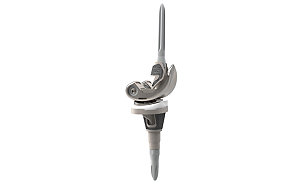
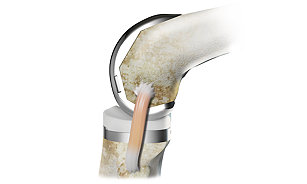
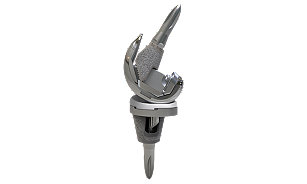
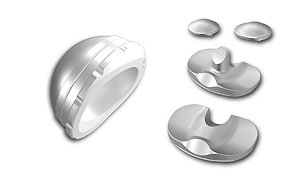
Triathlon TS

References

1. Stryker Orthopaedics Triathlon CR Tibial Inserts made from X3 UHMWPE, 5530-G-409 show a 68% reduction in volumetric wear rate versus the same insert fabricated from N2\Vac gamma sterilized UHMWPE, 5530-P-409. The insert tested was Size 4, 9 mm thick. Testing was conducted under multiaxial knee simulator (multi-station MTS knee joint simulatora) for five million cycles using appropriate size CoCr counterfaces, a specific type of diluted calf serum lubricant and the motion and loading conditions, representing normal walking, outlined in ISO/DIS 14243-3. Volumetric wear rates were 17.7 ± 2.2 mm3/106 cycles for standard polyethylene inserts and 5.7 ± 1.5 mm3/106 cycles for test samples. Test inserts were exposed to a gas plasma sterilization process. In vitro knee wear simulator tests have not been shown to quantitatively predict clinical wear performance.

2. Stryker Orthopaedics Triathlon PS Tibial Inserts made of X3 UHMWPE, 5532-G-409 show a 64% reduction in volumetric wear rate versus the same insert fabricated from N2\Vac gamma sterilized UHMWPE, 5532-P-409. The insert tested was Size 4, 9 mm thick. Testing was conducted under multiaxial knee simulator (multi-station MTS knee joint simulatora) for five million cycles using a size 7 CoCr counterfaces, a specific type of diluted calf serum lubricant and literature or fluoroscopy based motion and loading conditions representing stair climbing. Volumetric wear rates were 3.6 ± 0.61 mm3/106 cycles for standard polyethylene inserts and were 1.3 ± 0.44 mm3/106 cycles for test samples. Test inserts were exposed to a gas plasma sterilization process. In vitro knee wear simulator tests have not been shown to quantitatively predict clinical wear performance.

3. Stryker Orthopaedics Scorpio CR Tibial Inserts made from X3 UHMWPE, 72-22-0708, show a 79% reduction in volumetric wear rate versus the same insert fabricated from N2\Vac gamma sterilized UHMWPE, 72-2-0708. The insert tested was Size 7, 8 mm thick. Testing was conducted under multiaxial knee simulator (multi-station MTS knee joint simulatora) for five million cycles using appropriate size CoCr counterfaces, a specific type of diluted calf serum lubricant and the motion and loading conditions, representing normal walking, outlined in ISO/DIS 14243-3. Volumetric wear rates were 34.6 ± 1.5 mm3/106 cycles for standard polyethylene inserts and 7.3 ± 0.7 mm3/106 cycles for test samples. Test inserts were exposed to a gas plasma sterilization process. In vitro knee wear simulator tests have not been shown to quantitatively predict clinical wear performance.

4. Stryker Orthopaedics Scorpio PS Tibial Inserts made from X3 UHMWPE, 72-23-0708, show a 77% reduction in volumetric wear rate versus the same tibial insert fabricated from N2\Vac gamma sterilized UHMWPE, 72-3-0708. The insert tested was Size 7, 8 mm thick. Testing was conducted under multiaxial knee simulator (multi-station MTS knee joint simulatora) for five million cycles using appropriate size CoCr counterfaces, a specific type of diluted calf serum lubricant and literature or fluoroscopy based motion and loading conditions representing stair climbing. Volumetric wear rates were 35.8 ± 1.7 mm3/106 cycles for standard polyethylene inserts and were 8.2 ± 0.7mm 3/106 cycles for test samples. Test inserts were exposed to a gas plasma sterilization process. In vitro knee wear simulator tests have not been shown to quantitatively predict clinical wear performance.

5. Stryker Orthopaedics Trident Acetabular Inserts made of X3 UHMWPE (unsterilized), 721-00-32E, show a 97% reduction in volumetric wear rate versus the same insert fabricated from N2\Vac gamma sterilized UHMWPE, 620-00-32E. The insert tested was 7.5 mm thick with an inner diameter of 32 mm. Testing was conducted under multiaxial hip joint simulation for 5 million cycles using a 32 mm CoCr articulating counterface and calf serum lubricant. X3 UHMWPE Trident acetabular inserts showed a net weight gain due to fluid absorption phenomena but yielded a positive slope and wear rate in linear regression analysis. Volumetric wear rates were 46.39 ± 11.42 mm 3/106 cycles for N2\Vac gamma sterilized UHMWPE inserts and 1.35 ± 0.68 mm3/106 cycles for X3 UHMWPE (unsterilized) Trident Acetabular Inserts. Although in-vitro hip wear simulation methods have not been shown to quantitatively predict clinical wear performance, the current model has been able to reproduce correct wear resistance rankings for some materials with documented clinical results.

6. Yau SS,Wang A, Essner A,Manley M, Dumbleton J. “Sequential Irradiation and Annealing of Highly Crosslinked Polyethylenes: Resist Oxidation without Sacrificing Physical/Mechanical Properties,” Transactions of the 51st Annual Meeting of the Orthopaedic Research Society;Washington, DC, 2005: 1670.

7. D’Antonio J,Manley M, CapelloW, Bierbaum B, et al. “Five-year Experience with Crossfire Highly Cross-linked Polyethylene”. CORR, No 441, 2005, pp. 143-150.

8. Essner A, Yau SS, Schmidig G,Wang A, Dumbleton J,Manley M, Serekian P. “Reducing HipWearWithout Compromising Mechanical Strength: A Next Generation Crosslinked and Annealed Polyethylene,” Transactions of the 5th Combined Meeting of the Orthopaedic Research Societies of Canada, USA, Japan, and Europe; Calgary, Canada, 2004: 80.

9. X3 UHMWPE maintains mechanical properties for Tensile Yield Strength and Ultimate Tensile Strength of N2\Vac gamma sterilized UHMWPE as measured by ASTM D638. Tensile Yield Strength was 23.2 ± 0.4 MPa and 23.5 ± 0.3 Mpa for N2\Vac UHMWPE and X3 UHMWPE, respectively. Ultimate Tensile Strength was 54.8 ± 2.5 MPa and 56.7 ± 2.1 MPa for N2\Vac UHMWPE and X3 UHMWPE, respectively.

10. X3 UHMWPE virtually eliminates free radicals, as measured by Electron Spin Resonance (ESR). A very low (noise level, near instrument detection limit) concentration of residual free radicals was detected in the X3 UHMWPE. A 99% reduction of free radicals (14 ± 2 versus 1550 ± 32, 1014 spins/gram) was found when compared to N2\Vac gamma sterilized UHMWPE.

Motion:
Stryker Test Data RD-03-041 and RD-04-027

Better Fit:
Hitt, Kirby, et al. anthropometric Measurements for the Human Knee. Correlation to the Sizing of Current knee Arthroplasty Systems JBJS Vol. 85-A Sup. 4, 2003


Wear:

Stryker Orthopaedics Test Report RD-06-013.