Sales / General Contacts |
Product Quick Links
Mobile Bearing Hip™ System
ADM X3 is a large head solution for patients worldwide. Stryker now introduces MDM X3 – the first Modular Mobile Bearing Hip System. The Mobile Bearing Hip System complete with patented1 anatomic monoblock and modular shell options is designed to increase versatility to help orthopaedic surgeons address the wide breadth of reconstructive challenges that they may face.
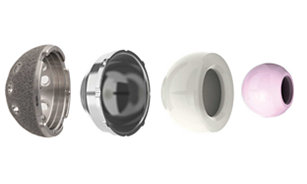
ADM and MDM X3 are dual mobility bearings with two points of articulation (Figure 1). The initial dual articulation system was invented by Professor Bousquet at the University Hospital of St. Etienne, France in 19762.
Dual mobility bearings marry two well-known concepts in THA.
• First, the Charnley Low Friction Arthroplasty (LFA) prosthesis has demonstrated clinically and radiologically that smaller diameter heads produce lower torque forces in the shell and consequently less wear2,3.
• Second, the large head concept from McKee-Farrar recognizes that a large diameter bearing is inherently more stable than a smaller diameter head2.
Features & Benefits
-
Stability4
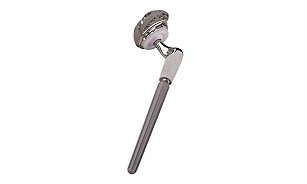
• ADM is greater than a hemisphere in some areas due to its anatomic design. ADM offers more than 88% greater jump distance than Biomet's E1 Active dual mobility bearing4,6 (Figure 2). Jump distance (mm) was measured with a 54mm shell at 45° of inclination and 20° of anteversion based upon three dimensional digital simulations*.
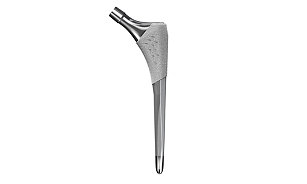
• ADM’s anatomic design also addresses psoas conflict. The left and right anatomical cup shapes incorporate a psoas cutout to help provide relief between the acetabular shell rim and the iliopsoas tendon (Figure 3).
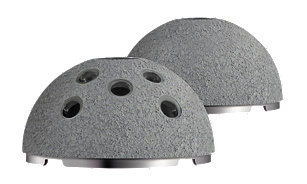
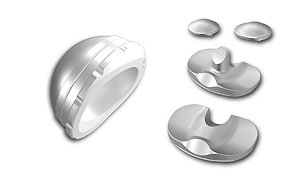
• MDM is Stryker’s Modular Dual Mobility system (Figure 4). In three dimensional simulations it also surpasses the jump distance of a traditional fixed and Biomet's E1 Active dual mobility bearing* 4,6.
*Three dimensional digital simulations of posterior horizontal dislocation demonstrate that for a given cup size the MDM and ADM designs surpass the jump height of a traditional fixed bearing and a competitive hard-on-hard device 4,6. Although resurfacing type shells have lower jump heights, they have the greatest ROM which is needed when the native femoral neck is retained 4,6. -
Longevity5
• The Mobile Bearing Hip System with X3 precisely engineered polyethylene is designed to help minimize the risk of wear and consequently help prolong the life of the implant5,8.
• Stryker’s patented X3 process ensures precisely engineered crosslinking to produce a uniquely wear resistant and strong polyethylene in hip and knee arthroplasty.†
• Early in-vivo clinical wear of Trident X3 was assessed via RSA (Radiostereometric Analysis). The authors concluded that 'X3 liners have wear properties superior to those of conventional polyethylene. Measurements between 1 and 2 years’ followup suggest wear is nearly undetectable, which is encouraging for the future clinical performance of this material’12. -
Advanced Fixation
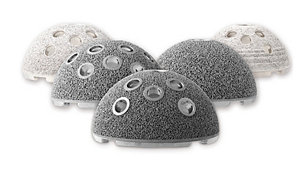
• MDM harnesses the fixation benefits of the patented Tritanium13 Advanced Fixation Technology and offers the option to use cancellous bone screws.
• Unlike other three dimensional fixation offerings composed of metal alloys, Tritanium is manufactured from a commercially-pure Titanium (CPTi) matrix.
References
† [7-11]
1. US Patent #7,833,276
2. Philippot, R., Camilleri, J. P., Boyer, B., et al. (2009). The use of a dual-articulation acetabular cup system to prevent dislocation after primary total hip arthroplasty: analysis of 384 cases at a mean follow-up of 15 years. SICOT 33: 927-932.
3. Wroblewski, B., Siney, P., Flemin, P. (2009). The principle of low frictional torque in the Charnley total hip replacement. JBJS (Br) Vol. 91-B(7): 855-858.
4. Heffernan, C. , Bhimji, S., Macintyre, J., et al. (2011). Development and Validation of a Novel Modular Dual Mobility Hip Bearing. ORS Annual Meeting Poster #1165.
5. Herrera, L., Lee, R., Longaray, J., et al. (2010). Edge Loading Wear due to Inclination Angle for Three Contemporary Hip Bearings. 56th Annual ORS Meeting. Poster #2259
6. Stryker Test Report RD-10-072.
7. US Patent #7,515,919.
8. Stryker Orthopaedics Restoration ADM X3 28 mm ID acetabular inserts made of X3 Gas Plasma Sterilized UHMWPE, show a 97% reduction in volumetric wear rate versus 28 mm ID Restoration ADM Duration Gamma. Radiation Sterilized UHMWPE. Both ADM constructs utilized a 54mm OD shell and the inserts were approximately 9.9mm thick. Testing was conducted under multi-axial hip joint simulation for 5 million cycles using a 28mm CoCr modular femoral head articulating counterface and calf serum lubricant. Volumetric wear rates were 109.7±6.0 mm3/106 cycles and -1.03 ± 3.8 mm3/106 cycles for Duration and X3 polyethylene insert test samples. Although in-vitro hip wear simulation methods have not been shown to quantitatively predict clinical wear performance, the current model has been able to reproduce correct wear resistance rankings for some materials with documented clinical results. 1-3
[1] Wang, A, et. al., Tribology International, Vol. 31, No. 1-3: 17-33, 1998.
[2] Essner, A. et. al., 44th Annual Meeting, ORS, New Orleans, Mar. 16-19, 1998: 774.
[3] Essner, A. et. al., 47th Annual Meeting, ORS, San Francisco, Feb. 25-28, 2001: 1007.
9. Stryker Orthopaedics Triathlon PS Tibial Inserts made of X3 UHMWPE, 5532-G-409 show a 64% reduction in volumetric wear rate versus the same insert fabricated from N2\Vac gamma sterilized UHMWPE, 5532-P-409. The insert tested was Size 4, 9mm thick. Testing was conducted under multiaxial knee simulator (multi-station MTS knee joint simulator for five million cycles using a size 7 CoCr counterfaces, a specific type of diluted calf serum lubricant and literature or fluoroscopy based motion and loading conditions representing stair climbing. a, b Volumetric wear rates were 3.6 ± 0.61 mm3 /106 cycles for standard polyethylene inserts and were 1.3 ± 0.44 mm3/106 cycles for test samples. Test inserts were exposed to a gas plasma sterilization process. In vitro knee wear simulator tests have not been shown to quantitatively predict clinical wear performance.
10. X3 UHMWPE maintains mechanical properties after accelerated oxidative aging. No statistical difference was found for Tensile Yield Strength, Ultimate Tensile Strength and Elongation as measured per ASTM D638 before and after exposure to ASTM F2003 accelerated aging (5 Atmospheres (ATM) of oxygen at 70ºC for 14 days). Tensile Yield Strength was 23.5 ± 0.3 MPa and 23.6 ± 0.2 MPa, Ultimate Tensile Strength was 56.7 ± 2.1 MPa and 56.3 ± 2.3 MPa and Elongation was 267 ± 7% and 266 ± 9% before and after accelerated oxidative aging, respectively.
11. Essner, A., Yau, S., et al. Acetabular Liner Functional Fatigue Performance of Crosslinked UHMWPE. 51st Annual ORS Meeting. Poster #0245.
12. Campbell, D. G., Field, J. R., Callary, S. A. (2010). Second generation Highly Crosslinked X3 Polyetheylene Wear: A Preliminary Radiostereometric Analysis Study. CORR: Published Online 12 February 2010.
13. US Patent # 7,458,991, 7,740,795, 7,674,426.